
 ← LecturesLecture 05 · Know Your Faith, Holy Family Parish
- Invisible does not mean unreal, and a visible sign can communicate an invisible reality without being identical with it.
- The human person is one being, body and rational soul, so persons become accessible to one another through signs.
- God does not need signs. We do, and He meets us in the way suited to the nature He gave us.
- Our word follows reality; God’s creative Word gives reality.
- That Word became flesh: in Christ the invisible God became encounterable.
- A sacrament is an efficacious sign: Christ, the principal agent, acts through it and gives the grace it signifies.
- The sign does not end in itself; it brings us into participation in divine life.
A smile is not the affection it expresses. A handshake is not the peace or reconciliation it may communicate. A wedding ring is not the covenant itself. Yet these visible realities can genuinely communicate invisible realities. They are not meaningless decorations.
God does not need signs. We do.
Invisible does not mean unreal
Some realities are directly available to the senses, while others are not. A body is visible. A smile is visible. A spoken sentence has a physical sound. But love, friendship, forgiveness, intention, justice, memory, trust, and thought are not themselves things the eyes can see or the hands can hold.
The important philosophical point is immediate: invisible does not mean unreal. The opposite of visible is not imaginary. A person can be affected by forgiveness, guided by an intention, bound by a covenant, or changed by love even though none of these realities can be weighed like a stone.
A smile is not the affection it expresses. A handshake is not the peace or reconciliation it may communicate. A wedding ring is not the covenant itself. Two hands meet physically, but the meaning can be relational: agreement, peace, recognition, respect, reconciliation, solidarity. Gold can be weighed and measured, but the ring can signify covenant, promise, belonging, history, fidelity, and public commitment.
A visible sign can genuinely communicate an invisible reality without being identical with that reality.
Scripture repeatedly gives visible covenantal signs: the rainbow (Genesis 9:12–17), circumcision (Genesis 17:9–14), Passover (Exodus 12), and later water, oil, laying on of hands, bread, wine, touch, and spoken blessing. The Bible is therefore not foreign to the logic of visible signs communicating invisible realities.
- A smile
- A handshake
- A wedding ring
- The rainbow
- Affection
- Peace, reconciliation
- Covenant, fidelity
- God’s covenant with every creature
The sign is real, and its meaning exceeds the physical thing.
The sign is not the reality, yet it can truly communicate the reality.
2 witnesses: 2 Corinthians 4:18, Genesis 9:12–13
…because we look not to the things that are seen but to the things that are unseen; for the things that are seen are transient, but the things that are unseen are eternal.
St Paul teaches that what is unseen is not less real, but more lasting.
This is the sign of the covenant which I make between me and you and every living creature that is with you, for all future generations: I set my bow in the cloud, and it shall be a sign of the covenant between me and the earth.
Scripture tells us that God Himself gave a visible sign of an invisible covenant.
PonderCan something be invisible and still objectively real? Name three examples from your own life.
Reality, concept, name, sign
Suppose I experience pleasure. The reality of pleasure is one thing. The English word “pleasure” is another. French uses a different word. Another language uses another sound. A child can experience pleasure before knowing any word for it. The reality does not come into existence because we have named it.
This is true of love, justice, friendship, forgiveness, beauty, peace, sorrow, trust, and covenant. We encounter and participate in such realities before we have perfect language for them. Reality is objective; the intellect can know it truly, though not exhaustively; language gives conventional signs to what the intellect has grasped.
This protects philosophical realism. We do not manufacture reality by naming it. We discover an intelligible order that precedes our naming. Our knowledge is genuine, but finite. God knows creatures perfectly because He is their Creator; we know them as creatures, by receiving, experiencing, comparing, reasoning, remembering, and forming concepts.
Our expression is also smaller than our interior participation. When I say, “I love you,” the sound is a sign, but it cannot contain the entire history, knowledge, memory, gratitude, desire for your good, and personal commitment that may constitute that love.
We can participate in a reality more deeply than any single sign can communicate it. The sign can be faithful without being exhaustive.
- Reality is given
- The intellect apprehends it
- Language names it
- The sign communicates it
Naming does not create the reality; it follows what the mind has grasped.
Reality is given; the intellect apprehends it; language names it.
2 witnesses: St Thomas Aquinas, Summa Theologiae I q.13 a.1, Genesis 2:19
According to the Philosopher, words are signs of ideas, and ideas the similitude of things.
St Thomas teaches that words signify things by way of the mind’s grasp of them.
So out of the ground the LORD God formed every beast of the field and every bird of the air, and brought them to the man to see what he would call them; and whatever the man called every living creature, that was its name.
Scripture shows the creatures given first, and the name given after.
PonderIf two languages use different words for the same reality, what does that tell us about words and realities?
The human person is both visible and invisible
The human person is one being, a unity of body and rational soul. Because we are this unity, our bodily and spiritual dimensions belong to one human existence. My body is visible. My intellect, will, intention, memory, judgment, and love are not visible in themselves. Yet both belong to one person.
I cannot put friendship into your hand as a physical object. I cannot put forgiveness into your hand. I cannot put peace or love into your hand. But I can shake your hand, embrace you, smile at you, speak, write, look at you, serve you, or give you a gift. My body becomes a means by which something of my interior life becomes accessible to you.
If we were purely bodily creatures, what we exchanged would ultimately be nothing beyond physical processes. Yet “I forgive you” is not merely sound waves, and “I love you” is not merely vibration in the air. The physical sign is real, but the personal reality communicated through it is not reducible to the physical sign.
The human person is therefore neither a spirit trapped in matter nor a body with no interior depth.
A physical sign can carry an interior, personal reality without being reducible to the physical sign.
3 witnesses: Genesis 2:7, CCC 362, CCC 365
then the LORD God formed man of dust from the ground, and breathed into his nostrils the breath of life; and man became a living being.
Scripture gives the image of man formed from the dust and given life by the breath of God.
The human person, created in the image of God, is a being at once corporeal and spiritual.
The Church teaches that the human person is at once bodily and spiritual.
The unity of soul and body is so profound that one has to consider the soul to be the “form” of the body: i.e., it is because of its spiritual soul that the body made of matter becomes a living, human body; spirit and matter, in man, are not two natures united, but rather their union forms a single nature.
The Church teaches that body and soul form a single nature, not two things joined.
PonderWhy does being a unity of body and soul make visible signs important to human communion?
We live by visible signs
Because we are embodied persons, signs are not a luxury added to human life. They are part of the way human beings know, reveal themselves, and enter into communion.
- A smile can communicate welcome or affection.
- A handshake can communicate peace, agreement, recognition, or reconciliation.
- A tear can reveal sorrow.
- A wedding ring can communicate covenant and belonging.
- A gift can communicate gratitude or love.
- A kneeling posture can communicate worship, reverence, or submission.
- A spoken promise can bind one person to another.
The point is not that every gesture has one fixed meaning. Context matters. The point is that human beings habitually use the visible and audible world to communicate realities that are not themselves visible.
What are we doing when we use a sign? I have encountered some reality. I have grasped something of it. I seek to express or communicate what I know. Because I am embodied, I give that communication a perceptible form. Another person perceives the sign and is led toward what I am communicating. Thus the sign mediates. It stands between persons without replacing either person.
I cannot simply open my interior life and place it directly inside your consciousness. You encounter me through my face, voice, actions, words, touch, and bodily presence. Through these you come to know me, trust me, respond to me, forgive me, love me, and enter into communion with me. Signs are not merely how we know things; they are how persons become accessible to one another.
Because access is embodied, a person who cannot see cannot receive a facial expression visually, and a person who cannot hear cannot receive spoken words auditorily. But human beings can adapt through other embodied channels. The point is not that disability prevents communion. The point is that human communion is ordinarily mediated through embodiment.
We reveal ourselves by degrees. A stranger receives little. A friend receives more. A spouse can receive an extraordinary depth of self-disclosure. Children receive a great deal through their parents. This is an ordering of communion, responsibility, and intimacy, not a ranking of human worth. But the image has a limit: God is not simply the innermost creaturely relationship. God is the transcendent source and final end of every creature. No creature can occupy the absolute center that belongs to God.
If signs make one person accessible to another, how can human beings participate in the life of the invisible God?
Signs are not merely how we know things; they are how persons become accessible to one another.
2 witnesses: CCC 1146, 1 John 4:20
In human life, signs and symbols occupy an important place. As a being at once body and spirit, man expresses and perceives spiritual realities through physical signs and symbols. As a social being, man needs signs and symbols to communicate with others, through language, gestures, and actions. The same holds true for his relationship with God.
The Church teaches that, as body and spirit, man perceives spiritual realities through physical signs, with others and with God.
If any one says, “I love God,” and hates his brother, he is a liar; for he who does not love his brother whom he has seen, cannot love God whom he has not seen.
St John teaches that love of the unseen God is bound up with love of the brother we see.
PonderWhat does it mean to say that signs make persons accessible to one another?
Does God need signs?
Answer plainly: no. God does not need signs.
God is not an embodied creature whose interior life must be communicated through a face, voice, gesture, or physical object. God knows Himself perfectly. He does not need language to understand Himself. He does not need a smile to express His love or a handshake to establish His intention.
So why does God use signs? Because we do.
This is a key movement from philosophy into theology. God accommodates His communication to the nature of the creature He has made. He can communicate to us through created realities because we are embodied persons who receive knowledge and communion through embodied signs.
But God does more than communicate information about Himself. He desires to communicate Himself. He calls, covenants, reveals, and draws creatures into communion with Him. The sacramental question is therefore not merely “How does God tell us about grace?” but “How does God bring embodied human beings into His own life?”
God does not need signs; we do, and He meets us in the way suited to the nature He has given us.
2 witnesses: St Thomas Aquinas, Summa Theologiae III q.61 a.1, CCC 1257
Sacraments are necessary unto man’s salvation for three reasons. The first is taken from the condition of human nature which is such that it has to be led by things corporeal and sensible to things spiritual and intelligible.
St Thomas teaches that the sacraments answer to our nature, which is led through bodily things to spiritual ones.
God has bound salvation to the sacrament of Baptism, but he himself is not bound by his sacraments.
The Church teaches that the sacraments bind us, not God: He gives them for our sake.
PonderWhy does God not need signs, while we do?
The Divine Word does what our words cannot do
Our words ordinarily signify a reality that we have encountered or know. I can say, “I am happy,” but the sentence does not create my happiness. I can say, “I forgive you,” and my words can truly express an act of forgiveness, but my syllables do not create the universe. Our word normally follows reality.
God’s Word is different. Scripture presents God’s speech as effective: “God said, ‘Let there be light’; and there was light” (Genesis 1:3). “By the word of the LORD the heavens were made” (Psalm 33:6).
John reveals the deepest truth: “In the beginning was the Word … all things were made through him” (John 1:1–3). The Word is not merely a sound proceeding from God. The Word is the eternal Son.
For us, the word follows reality. For God, His creative Word gives reality.
This is not magic in syllables. A sound has no autonomous power. The efficacy belongs to God.
The sacramental words are therefore not magical formulas. Their efficacy does not come from the sound itself or from the personal holiness of the minister. The sacramental action belongs to Christ, the Divine Word made flesh, acting through the visible rite.
The word is joined to the element and the sacrament comes to be. (St Augustine)
- Follows reality
- Signifies what we know
- Cannot create its object
- A sound with no power of its own
- Gives reality
- Creates and acts
- “Let there be light”
- The eternal Son
The sacramental words act because they belong to Christ, the Word made flesh.
For us, the word follows reality; for God, His creative Word gives reality.
4 witnesses: Genesis 1:3, Psalm 33:6, John 1:1–3…
And God said, “Let there be light”; and there was light.
These words are drawn from the Book of Genesis, where God’s word brings about what it says.
By the word of the LORD the heavens were made, and all their host by the breath of his mouth.
These words are drawn from the Psalms.
In the beginning was the Word, and the Word was with God, and the Word was God. He was in the beginning with God; all things were made through him, and without him was not anything made that was made.
These words are drawn from St John, who teaches that the creative Word is the eternal Son.
Accedit verbum ad elementum, et fit sacramentum. (The word is added to the element, and there results the sacrament.)
These words are drawn from St Augustine. The lecture notes cite Sermon 272; the line is from Tractate 80 on St John. CCC 1228 cites it.
PonderWhat is the difference between a human word that signifies and God’s Word that creates?
The Incarnation: the invisible God becomes encounterable
The Incarnation is the decisive fulfillment of everything we have established. The invisible God does not merely send information about Himself. The Word becomes flesh.
“Whoever has seen me has seen the Father” (John 14:9). Christ is “the image of the invisible God” (Colossians 1:15). Hebrews calls the Son the radiance of God’s glory and the exact imprint of His being (Hebrews 1:3).
That which we have heard, which we have seen with our eyes, which we have looked upon and touched with our hands… (1 John 1:1)
Christianity is therefore not merely information about God. In Christ, God makes Himself encounterable within human history. The Son is seen, heard, touched, followed, and received.
This is why sacramentality is Christological. Christianity does not first begin with an abstract spiritual world and then add matter later. The faith begins with the claim that the eternal Word truly assumed human nature. God uses visible realities not because matter is divine, but because the Son truly became flesh.
Christ does not cease to act when His visible earthly ministry ends. His Body, the Church, receives and celebrates the sacramental mysteries. Vatican II describes the Church, in Christ, as a sacrament or sign and instrument of intimate union with God and of the unity of the human race (Lumen gentium 1).
What was visible in our Redeemer has passed over into the sacraments. (St Leo the Great, Sermon 74.2)
The sacraments are not substitutes for Christ. They are the means by which Christ continues to make His saving action present to His Church.
The sacramental economy grows out of the Incarnation: the Son truly became flesh.
5 witnesses: John 14:9, Colossians 1:15, 1 John 1:1…
He who has seen me has seen the Father.
These words are drawn from St John. The lecture cites them in another English translation; the RSV-CE wording is given here.
He is the image of the invisible God, the first-born of all creation.
These words are drawn from St Paul.
That which was from the beginning, which we have heard, which we have seen with our eyes, which we have looked upon and touched with our hands, concerning the word of life.
These words are drawn from St John, who bears witness to the Word he saw and touched.
What was visible in our Redeemer has passed over into the sacraments.
These words are drawn from St Leo. CCC 1115 cites them in another translation: “what was visible in our Savior has passed over into his mysteries.”
The Church is in Christ like a sacrament or as a sign and instrument both of a very closely knit union with God and of the unity of the whole human race.
The Council teaches that the Church, in Christ, is a sign and instrument of union with God.
PonderWhy is the Incarnation central to sacramental theology?
What is a sacrament?
The Catechism gives the definition in which these questions converge:
The sacraments are efficacious signs of grace, instituted by Christ and entrusted to the Church, by which divine life is dispensed to us. (CCC 1131)
- Sign: something perceptible that communicates an invisible divine reality.
- Efficacious: the sign does not merely describe or remind. Christ uses it as an instrument through which grace is truly communicated.
- Of grace: the sacramental gift is not merely psychological encouragement or communal identity. It is participation in divine life.
- Instituted by Christ: the sacraments belong to Christ’s saving action, not merely to later ecclesial invention.
- Entrusted to the Church: the Church receives, guards, celebrates, and administers what Christ entrusted to her.
- Divine life is dispensed: the purpose is communion with God, not the sign for its own sake.
This is the decisive distinction from ordinary signs. My smile signifies affection but does not create affection. Baptism signifies cleansing and rebirth, but Christ acts through the sacramental sign and gives the grace signified.
The classical language of matter and form helps us see that a sacrament is not simply an object. Water by itself is not Baptism. Words by themselves are not Baptism. The divinely instituted sacramental action has visible and verbal elements ordered together. In Baptism, water belongs to the sacramental sign and the Trinitarian words are essential to its form (Matthew 28:19). In the Eucharist, bread and wine belong to the matter, and the Eucharistic prayer includes the institution narrative and consecratory words (CCC 1352, 1412).
Christ is the principal agent; the sacrament is His instrument. A carpenter uses a saw, and the saw genuinely cuts, but it does so as an instrument of the carpenter. A surgeon acts through a scalpel in the same way. So water does not contain divine life as a chemical property. Oil does not contain sanctifying grace as a physical substance. Bread and wine do not become Christ by chemistry. Christ takes created realities into His saving action and uses them sacramentally. The Catechism calls the sacraments the “masterworks of God” (CCC 1116), and CCC 1120 and 1548 protect the same principle: the minister is a true instrument, but Christ remains the principal agent.
Ex opere operato means that a sacrament derives its sacramental efficacy from Christ’s action in the sacramental rite, not from the minister’s private holiness. This does not mean that sacramental life is mechanical or magical. A sacrament can be objectively valid while its fruits are impeded or received fruitfully according to the person’s disposition (CCC 1127–1129, 1131, 1133).
- My smile communicates affection
- It does not create affection
- Human words make something known
- Baptism signifies cleansing and rebirth
- Christ acts through it and gives grace
- Sacramental words belong to Christ’s action
The minister and the sign are true instruments; Christ is the principal agent.
A smile signifies affection but does not create it; a sacrament signifies grace, and Christ acts through it to give the grace signified.
4 witnesses: CCC 1131, CCC 1128, CCC 1116…
The sacraments are efficacious signs of grace, instituted by Christ and entrusted to the Church, by which divine life is dispensed to us. The visible rites by which the sacraments are celebrated signify and make present the graces proper to each sacrament. They bear fruit in those who receive them with the required dispositions.
These words are drawn from the Catechism, and the lecture unfolds them word by word.
This is the meaning of the Church’s affirmation that the sacraments act ex opere operato (literally: “by the very fact of the action’s being performed”), i.e., by virtue of the saving work of Christ, accomplished once for all… Nevertheless, the fruits of the sacraments also depend on the disposition of the one who receives them.
The Church teaches that sacraments act by the work of Christ, while their fruit depends on the disposition of the one who receives.
Sacraments are “powers that comes forth” from the Body of Christ, which is ever-living and life-giving. They are actions of the Holy Spirit at work in his Body, the Church. They are “the masterworks of God” in the new and everlasting covenant.
These words are drawn from the Catechism. The lecture notes give CCC 1084; the phrase stands in CCC 1116.
Go therefore and make disciples of all nations, baptizing them in the name of the Father and of the Son and of the Holy Spirit.
Our Lord gives the Trinitarian words that are the form of Baptism.
PonderWhat is the difference between saying “this reminds me of Christ” and saying “Christ acts here through the sacrament”?
Supernatural, not magic: toward divine life
At the natural level, a sign communicates a reality. At the sacramental level, Christ takes the natural sign into His own action and uses it to communicate a grace that nature cannot produce by its own powers.
Water remains water. Oil remains oil. Human speech remains human speech. Bodily actions remain bodily actions. What changes is not the physical identity of the material into something magical, but the action in which Christ incorporates that created sign.
This is why sacramental faith is not magic. Magic imagines that a technique or formula carries autonomous power that a human being can manipulate. Sacramental faith says the opposite: the power belongs to God; Christ is the principal agent; the sign is His instrument; the Church receives and administers what He has entrusted. The supernatural therefore does not abolish nature. God uses nature and elevates it to an end beyond what created nature can accomplish by itself.
The sacrament does not terminate in the visible object. The visible sign serves a greater end: communion with God. In human life, signs make one person accessible to another. In sacramental life, Christ makes divine life accessible to us. The analogy is not identity, because God is not a finite human person and sacramental efficacy is supernatural.
This is why grace must not be imagined as a physical substance sitting inside water, oil, bread, wine, or an object waiting to be transferred mechanically. Grace is God’s gratuitous gift of participation in His own life. The objective action belongs to Christ. Our fruitful participation involves the reception and response of the person: faith, repentance, charity, openness, and, according to the sacrament, the proper disposition.
- Visible sign
- Sacramental action
- Christ’s action
- Grace
- Participation in divine life
- Transformation
The sign does not end in itself: it serves communion with God.
Grace is not a thing inside water or oil; it is God’s gift of participation in His own life.
3 witnesses: 2 Peter 1:4, CCC 1996, St Thomas Aquinas, Summa Theologiae I q.1 a.8 ad 2
…by which he has granted to us his precious and very great promises, that through these you may escape from the corruption that is in the world because of passion, and become partakers of the divine nature.
St Peter teaches that God’s gifts make us partakers of the divine nature.
Our justification comes from the grace of God. Grace is favor, the free and undeserved help that God gives us to respond to his call to become children of God, adopted sons, partakers of the divine nature and of eternal life.
The Church teaches that grace is God’s free gift, by which we become partakers of the divine nature.
Since therefore grace does not destroy nature but perfects it, natural reason should minister to faith.
St Thomas teaches that grace perfects nature rather than abolishing it.
PonderWhat does participation in divine life mean, and why is it more than receiving a religious object or feeling?
Seven sacraments, one sacramental life
Once the sacramental principle is clear, the seven sacraments are no longer seven unrelated rituals. They accompany the major dimensions of Christian existence under grace.
- Christian initiation: Baptism, Confirmation, Eucharist. Birth, strengthening, nourishment, incorporation.
- Healing: Penance, Anointing of the Sick. Restoration and strengthening amid sin and bodily weakness.
- At the service of communion: Holy Orders, Matrimony. Covenant, service, generation, and communion.
The traditional analogy with natural life is useful: human beings are born, grow, are nourished, become wounded or sick, receive care, form households, and take up vocations of service. Grace accompanies the whole Christian person.
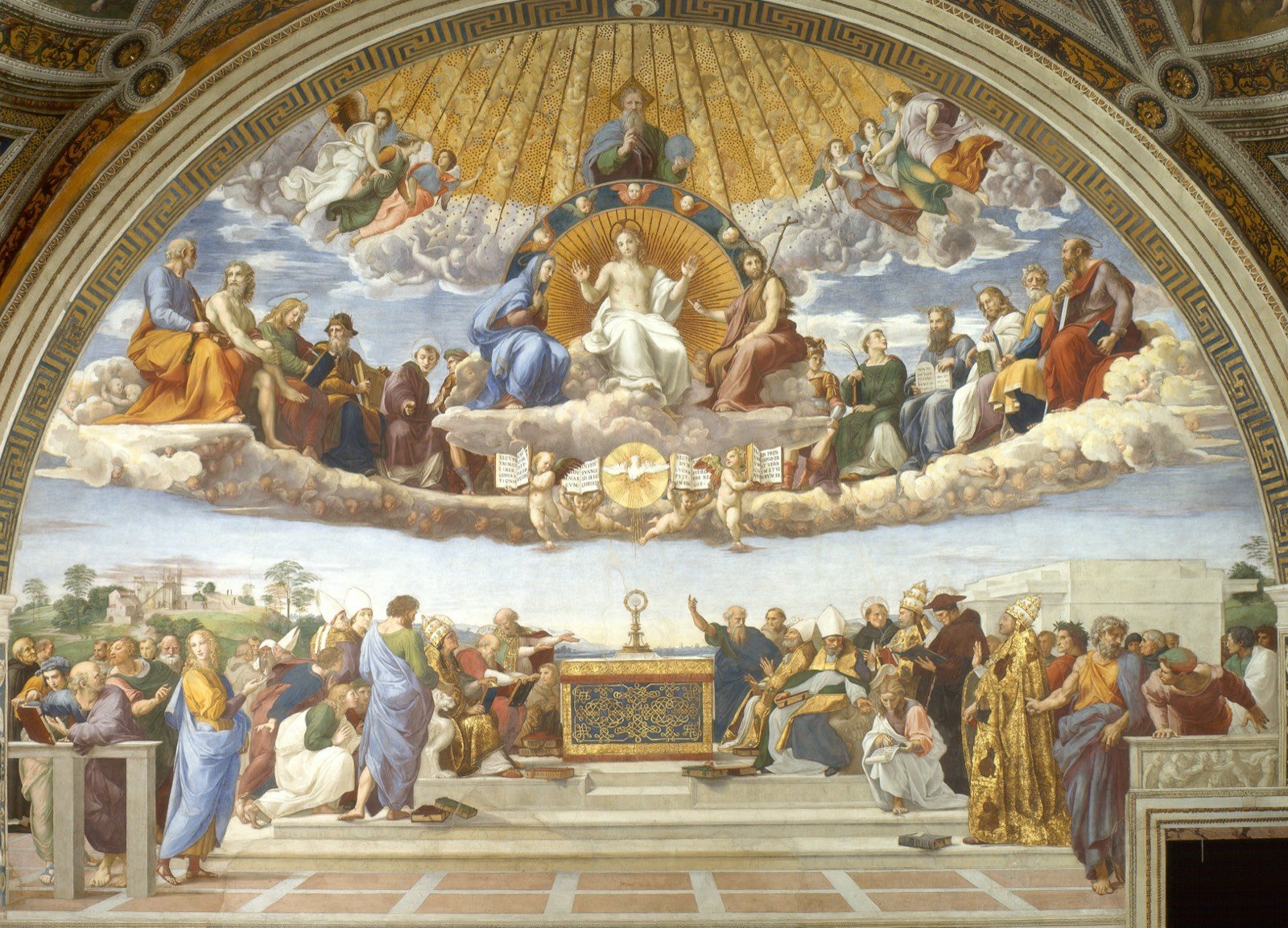
The Eucharist is the source and summit of the Christian life (CCC 1324). Here appearances do not exhaust reality. Accidents are sensible properties such as color, taste, texture, and quantity. Substance refers to what a thing is in itself. In transubstantiation, the substance of bread and wine is changed into the substance of Christ’s Body and Blood, while the species or appearances remain (CCC 1376).
The Eucharist is not a case of “Jesus hiding underneath the bread.” The claim is more precise: the deepest ontological reality has changed while sensible appearances remain.
What you see is bread, and what you believe is the Body of Christ.
St Cyril of Jerusalem likewise teaches the baptized to trust Christ’s word concerning the Eucharist. The Fathers do not use the later scholastic terminology, but their witness is strongly Eucharistic and realist.
| Sacrament | Sign (matter and form) | Minister | What it effects |
|---|---|---|---|
| Baptism | Water, with “I baptize you in the name of the Father, and of the Son, and of the Holy Spirit” | Bishop, priest, deacon; in necessity anyone | New birth, forgiveness of original and personal sin, incorporation into Christ; an indelible character |
| Confirmation | Chrism on the forehead with the laying on of hands: “Be sealed with the Gift of the Holy Spirit” | Ordinarily the bishop | Strengthening with the Holy Spirit for witness and mission; an indelible character |
| Eucharist | Wheat bread and grape wine, with the words of consecration | Priest | Christ truly present, Body, Blood, Soul and Divinity; the one sacrifice of Calvary made present; communion |
| Penance | Contrition, confession and satisfaction, with the priest’s absolution | Priest | Forgiveness of sins after Baptism and reconciliation with the Church |
| Anointing of the Sick | Blessed oil on forehead and hands, with the prayer of the priest | Priest or bishop | Strength, peace, forgiveness of sins, union with Christ in suffering, sometimes healing |
| Holy Orders | Laying on of hands and the prayer of consecration | Bishop | Configuration to Christ for apostolic service in three degrees; an indelible character |
| Matrimony | Free consent of a baptized man and woman | The spouses, before the priest or deacon | A lifelong covenant and grace for married life |
Initiation, healing, and service of communion: one sacramental life (CCC 1210–1211).
The seven sacraments are one life of grace, from birth to vocation, and the Eucharist is its source and summit.
4 witnesses: CCC 1210, CCC 1376, St Augustine, Sermon 272…
The seven sacraments touch all the stages and all the important moments of Christian life: they give birth and increase, healing and mission to the Christian’s life of faith. There is thus a certain resemblance between the stages of natural life and the stages of the spiritual life.
The Church teaches that the sacraments follow the stages of natural life.
By the consecration of the bread and wine there takes place a change of the whole substance of the bread into the substance of the body of Christ our Lord and of the whole substance of the wine into the substance of his blood. This change the holy Catholic Church has fittingly and properly called transubstantiation.
The Church teaches that the substance changes while the appearances remain.
What you can see, then, is bread and a cup; that is what even your eyes tell you; but as for what your faith asks to be instructed about, the bread is the body of Christ, the cup the blood of Christ.
St Augustine teaches the newly baptized to move from what the eyes see to what faith receives. The lecture notes give this line to St Ambrose; its wording is closest to this sermon of St Augustine.
Contemplate therefore the Bread and Wine not as bare elements, for they are, according to the Lord’s declaration, the Body and Blood of Christ; for though sense suggests this to thee, yet let faith establish thee.
St Cyril teaches the baptized to trust Christ’s word above the senses.
PonderWhich of the seven sacraments most vividly shows the difference between signifying and supernatural efficacy?
Distinctions that matter
| Distinction | Do not confuse them | Why it matters |
|---|---|---|
| Visible sign and invisible reality | A smile is not affection; a ring is not the covenant. | The sign can communicate the reality without being identical with it. |
| Reality and name | A word does not create a reality simply by naming it. | Protects realism and prepares for God’s creative Word. |
| Human word and Divine Word | Our word ordinarily signifies; God’s Word creates and acts. | Explains the supernatural source of sacramental efficacy. |
| Embodied sign and direct access | We ordinarily encounter persons through bodily signs. | Grounds human communion and sacramental mediation. |
| Natural sign and sacramental sign | A smile communicates; a sacrament communicates and, by Christ’s action, effects grace. | Causality is elevated beyond natural signification. |
| Minister and principal agent | The minister acts; Christ is the principal agent. | Protects both the reality of ministry and the primacy of Christ. |
| Objective efficacy and personal fruitfulness | The sacrament is Christ’s efficacious action; disposition affects fruitfulness. | Protects sacramental realism and personal responsibility. |
| Appearance and substance | What the senses perceive does not exhaust what is. | Essential to Eucharistic realism and transubstantiation. |
| Grace and physical substance | Grace is divine life, not a material thing. | Prevents magical or mechanistic thinking. |
Study it
For a group or on your own. Tick each question as you answer it; your ticks stay on this device.
- Invisible does not mean unreal; a visible sign can communicate an invisible reality without being identical with it.
- Reality is given, the intellect apprehends it, and language names it; we participate in realities more deeply than any sign can express.
- The human person is one being, body and rational soul, and persons become accessible to one another through signs.
- God does not need signs. We do, and He meets us in the way suited to our nature.
- Our word follows reality; God’s creative Word gives reality, and that Word became flesh in Christ.
- A sacrament is an efficacious sign of grace instituted by Christ and entrusted to the Church; Christ is the principal agent and the sign His instrument.
- Sacraments act by Christ’s action, not the minister’s holiness, while their fruit depends on the disposition of the one who receives.
- The seven sacraments form one life of grace, with the Eucharist as its source and summit, bringing us into participation in divine life.
“What was visible in our Redeemer has passed over into the sacraments.”St Leo the Great, Sermon 74.2
Godhead here in hiding, whom I do adore, Masked by these bare shadows, shape and nothing more, See, Lord, at thy service low lies here a heart Lost, all lost in wonder at the God thou art. Seeing, touching, tasting are in thee deceived; How says trusty hearing? that shall be believed; What God’s Son has told me, take for truth I do; Truth himself speaks truly or there’s nothing true.
St Thomas Aquinas, Adoro te devote, tr. Gerard Manley Hopkins