 ← LecturesLecture 02 · Rite of Christian Initiation of Adults (RCIA)
- Everyone is born into Adam’s family; baptism grafts us into Christ’s.
- By covenant, strangers become family, and each covenant widens the circle until Christ fulfils them all.
- Christ founds a new Israel on twelve apostles, as the old was built on twelve tribes.
- All the Twelve bind and loose; Peter alone receives the keys.
- The apostles laid hands on others, in a chain that reaches to today.
- Heaven, earth and purgatory are one body, bound by one Spirit.
- Baptism marks us for ever; mortal sin kills the life, not the mark, and confession restores it.
- Outside the ark, the flood: to know the Church and refuse her is to refuse life.
Blood is one way to become family. It is not the only way.
Every human being is born onto the tree of Adam’s line, inheriting a nature wounded by his disobedience. Christ, the new Adam, opens a second tree: through baptism, anyone from the first tree can be grafted onto the second, born again into his family, carried by the Church to every nation.
Two Adams, two families
In the first creation, God established in Adam the order of nature: the design and dignity proper to mankind, held together by the gift of original justice, the right ordering of man toward God, within himself, and toward others. Adam’s sin did not destroy this nature. Nature remains fundamentally good. But it wounded that nature, stripping away original justice and leaving it subject to ignorance, suffering, disordered desire, and death.
Because all mankind descends from Adam by natural generation, this wounded condition, not a personal guilt for Adam’s own act but a deprivation of the gift he was meant to hand on, is transmitted to everyone born into his family line: the whole human race.
In a second creation, a new family tree is established in Christ, the new Adam. Where the first Adam disobeyed, Christ obeys, even to death on a cross, and by that obedience many are made righteous. Through him we receive adoption as sons, no longer merely creatures but children. We are grafted into this new family tree through baptism, becoming members of the body of Christ and of his own divine family.
Because we are his members, we receive his own Spirit, who bonds us to the Father and to one another, a bond mere generation could never transmit and that only grace can give. Everyone is born onto the first tree. Baptism is what grafts a person onto the second.
As in Adam all die, so in Christ all will be made alive. (1 Corinthians 15:22)
- Adam and Eve, our first parents
- Many generations
- All mankind, by birth
- A wounded nature inherited
- Jesus Christ, the new Adam
- Through the apostles
- All the baptized, by invitation
- Adoption as sons received
Everyone is born onto the first tree. Baptism grafts a person onto the second.
Both trees reach all mankind: one by birth, one by invitation.
3 witnesses: 1 Corinthians 15:22, Romans 5:19, CCC 405
For as in Adam all die, so also in Christ shall all be made alive.
These words are drawn from St Paul. The lecture cites them in another English translation; the RSV-CE wording is given here.
For as by one man’s disobedience many were made sinners, so by one man’s obedience many will be made righteous.
St Paul teaches that the obedience of Christ undoes the disobedience of Adam.
Although it is proper to each individual, original sin does not have the character of a personal fault in any of Adam’s descendants. It is a deprivation of original holiness and justice, but human nature has not been totally corrupted: it is wounded in the natural powers proper to it, subject to ignorance, suffering and to the dominion of death, and inclined to sin.
The Church teaches that original sin is a deprivation, not a personal fault, and that nature is wounded but not destroyed.
PonderOn which tree was I born, and on which tree do I now live?
The covenants: from strangers to family
Blood is one way to become family. It is not the only way. Beginning with Adam, God has revealed himself in history through a series of covenants, and it is by covenant that those who are not family by birth become family in his household.
Each covenant widens the circle further: with Adam and Noah, God binds himself to the whole human race; with Abraham, to a family; with Moses at Sinai, to a nation; with David, to a kingdom. The prophets then promise something greater still, a new and everlasting covenant written on the heart, and every one of these covenants finds its fulfillment in the covenant Christ seals in his own blood.
For all the promises of God find their Yes in him. (2 Corinthians 1:20)
- Adam and Noah: all humanity
- Abraham: a family
- Moses: a nation at Sinai
- David: a kingdom
- Christ: new and everlasting covenant
Every covenant is gathered up and fulfilled in the covenant Christ seals in his own blood.
Each covenant widens the family of God, and all of them are fulfilled in Christ’s New Covenant, not replaced by a separate one.
4 witnesses: 2 Corinthians 1:20, Jeremiah 31:31, 33, Luke 22:20…
For all the promises of God find their Yes in him. That is why we utter the Amen through him, to the glory of God.
These words are drawn from St Paul, who teaches that every promise of God is fulfilled in Christ.
Behold, the days are coming, says the LORD, when I will make a new covenant with the house of Israel and the house of Judah… I will put my law within them, and I will write it upon their hearts.
The Lord promises through the prophet a covenant written on the heart.
This cup which is poured out for you is the new covenant in my blood.
Our Lord seals the New Covenant in his own blood.
God, who creates and conserves all things by his Word, provides men with constant evidence of himself in created realities.
The Church teaches that God revealed himself in stages, through covenants with Noah, Abraham and Israel, leading to Christ.
PonderHow does a covenant make strangers into family?
A covenant is a marriage
Every one of these covenants is described in the language of marriage. Israel’s prophets picture the covenant as a wedding: Hosea’s own marriage becomes a living parable of it, and Ezekiel and Isaiah describe God’s covenant love in explicitly nuptial terms.
This is why idolatry, breaking covenant to chase after other gods, is named not merely as disobedience but as adultery and prostitution: unfaithfulness to a marriage, not simply a broken agreement.
The New Testament completes the image. Christ is the bridegroom, the Church his bride, a marriage consummated at the wedding feast of the Lamb.
Every covenant carries marriage imagery, which is why breaking it is called adultery.
3 witnesses: Hosea 2:19–20, Ephesians 5:31–32, Revelation 19:9
And I will betroth you to me for ever; I will betroth you to me in righteousness and in justice, in steadfast love, and in mercy. I will betroth you to me in faithfulness; and you shall know the LORD.
The Lord speaks of his covenant with Israel as a betrothal.
“For this reason a man shall leave his father and mother and be joined to his wife, and the two shall become one flesh.” This mystery is a profound one, and I am saying that it refers to Christ and the church.
St Paul teaches that marriage points to the union of Christ and the Church.
Blessed are those who are invited to the marriage supper of the Lamb.
Scripture speaks of the end of the story as a wedding feast.
PonderWhat changes when I think of my faith as a marriage rather than an agreement?
Twelve tribes, twelve apostles
The Old Covenant kingdom has a structure Christ deliberately echoes. Israel was built on twelve tribes, sons of one father, Jacob. When Christ forms his own Twelve, he is not assembling a random council. He is founding a new Israel, with himself as the true and final Son of the one Father.
Revelation makes the parallel explicit: the New Jerusalem has twelve gates bearing the names of the twelve tribes of Israel, and twelve foundations bearing the names of the twelve apostles of the Lamb. Christ himself tells the Twelve they will sit on twelve thrones, judging the twelve tribes of Israel.
The old kingdom of twelve tribes is the type. The new kingdom Christ founds on twelve apostles, with himself as king, is its fulfillment, the antitype.
Twelve tribes born of one father; twelve apostles called by one Lord.
| Old Israel: the tribes | New Israel: the apostles | |
|---|---|---|
| 1 | Reuben | Simon Peter |
| 2 | Simeon | Andrew |
| 3 | Levi | James the Great |
| 4 | Judah | John |
| 5 | Dan | Philip |
| 6 | Naphtali | Bartholomew |
| 7 | Gad | Thomas |
| 8 | Asher | Matthew |
| 9 | Issachar | James the Less |
| 10 | Zebulun | Jude Thaddaeus |
| 11 | Joseph | Simon the Zealot |
| 12 | Benjamin | Matthias |
Twelve gates named for the tribes, twelve foundations named for the apostles (Revelation 21:12–14). The rows match in number only.
Same pattern: twelve sons, one father, one people.
3 witnesses: Revelation 21:12, 14, Matthew 19:28, CCC 765
It had a great, high wall, with twelve gates, and at the gates twelve angels, and on the gates the names of the twelve tribes of the sons of Israel were inscribed… And the wall of the city had twelve foundations, and on them the twelve names of the twelve apostles of the Lamb.
These words are drawn from the Book of Revelation, where the tribes and the apostles stand together in the holy city.
Truly, I say to you, in the new world, when the Son of man shall sit on his glorious throne, you who have followed me will also sit on twelve thrones, judging the twelve tribes of Israel.
Our Lord himself joins the Twelve to the twelve tribes.
The Lord Jesus endowed his community with a structure that will remain until the Kingdom is fully achieved. Before all else there is the choice of the Twelve with Peter as their head. Representing the twelve tribes of Israel, they are the foundation stones of the new Jerusalem.
The Church teaches that the Twelve represent the twelve tribes and are the foundation of the new Jerusalem.
PonderWhy would Our Lord choose exactly twelve?
Christ’s household: the Twelve
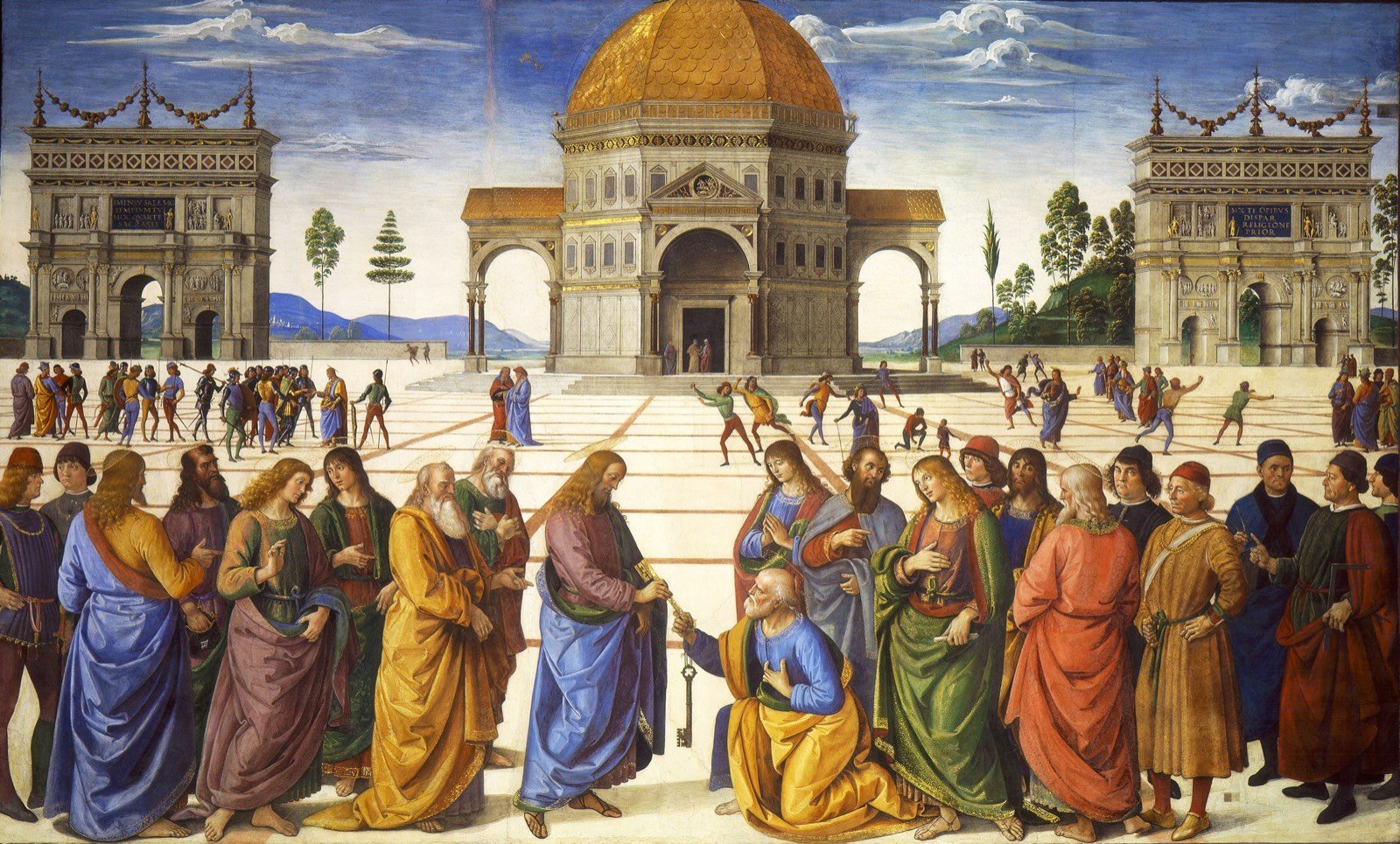
Christ’s family tree begins with the Twelve he calls directly to himself, chosen by him rather than appointed by one another. All twelve receive real authority: whatever they bind on earth is bound in heaven.
But one among them, Simon, is renamed Peter, rock, and given something the others are not given individually: the keys of the kingdom. The image is deliberate. In Isaiah 22, the king of Judah hands Eliakim the key of the house of David: he shall open, and none shall shut. Eliakim is the steward who controls access to the king, and the Church has always read Peter’s keys through that same image.
Peter is one of the Twelve, and he is also marked out as their head, the steward of the household, first among them.
Matthias took the place of Judas after his betrayal, chosen by lot after prayer, so that the number of the Twelve, broken by Judas’s fall, was restored before Pentecost.
All Twelve bind and loose; Peter alone holds the keys.
- Head of the Twelve
- Steward of the household
- Andrew
- James the Great
- John
- Philip
- Bartholomew
- Thomas
- Matthew
- James the Less
- Jude Thaddaeus
- Simon the Zealot
- Matthias
All Twelve are called directly by Christ (Mark 3:13–19). Peter stands among them as their head.
Peter is drawn inside the Twelve, not above them: one of the family, first among them.
4 witnesses: Matthew 16:18–19, Matthew 18:18, Isaiah 22:22…
And I tell you, you are Peter, and on this rock I will build my church, and the powers of death shall not prevail against it. I will give you the keys of the kingdom of heaven, and whatever you bind on earth shall be bound in heaven, and whatever you loose on earth shall be loosed in heaven.
Our Lord gives the keys to Peter alone.
Truly, I say to you, whatever you bind on earth shall be bound in heaven, and whatever you loose on earth shall be loosed in heaven.
Our Lord gives the power to bind and loose to the Twelve together.
And I will place on his shoulder the key of the house of David; he shall open, and none shall shut; and he shall shut, and none shall open.
These words are drawn from the prophet Isaiah. The steward’s key is the image behind Peter’s keys.
And they cast lots for them, and the lot fell on Matthias; and he was enrolled with the eleven apostles.
Scripture tells us how Matthias was numbered with the Twelve.
PonderWhat does a steward of the household do for the king and for the house?
Apostolic succession
The apostles did not keep this authority to themselves. They laid hands on others, and those men laid hands on others in turn, an unbroken chain historians can trace, in outline, to today.
Around the year 180, Irenaeus of Lyon, himself a disciple of Polycarp, who was a disciple of the apostle John, used exactly this argument against those inventing new teachings. He simply listed the bishops of Rome, one after another, back to Peter, and asked his opponents to do the same for their own doctrines. They could not.
The same kind of chain can be traced from other apostles too, spreading everywhere the Twelve preached, through many bishops history never bothered to name individually. Every validly ordained bishop today stands somewhere on a chain like this, reaching back, hand to hand, to an apostle Christ himself sent.
The hand that ordains today traces back to the hand of an apostle.
- Peter, at Rome
- Linus
- Over 260 more, by name
- Leo XIV, today
The same pattern repeats through the other apostles, many times over, mostly unnamed.
Every validly ordained bishop stands somewhere on a chain reaching back to an apostle.
3 witnesses: St Irenaeus of Lyon, Against Heresies III.3.3, St Clement of Rome, First Letter to the Corinthians 44, CCC 861
The blessed apostles, then, having founded and built up the Church, committed into the hands of Linus the office of the episcopate.
St Irenaeus names the bishops of Rome in order. He speaks of the Church at Rome as founded by both Peter and Paul.
Our apostles also knew, through our Lord Jesus Christ, that there would be strife on account of the office of the episcopate. For this reason… they appointed those ministers already mentioned, and afterwards gave instructions, that when these should fall asleep, other approved men should succeed them in their ministry.
St Clement teaches that the apostles provided for others to succeed to their ministry.
In order that the mission entrusted to them might be continued after their death, the apostles consigned, by will and testament, as it were, to their immediate collaborators the duty of completing and consolidating the work they had begun.
The Church teaches that the apostles handed on their mission to successors.
PonderWhy did St Irenaeus think a list of bishops answered a question about doctrine?
One body, three states
Everyone who belongs to Christ’s body, whether triumphant in heaven, still on pilgrimage on earth, or being purified in purgatory, shares the same Spirit and remains bound together in a single communion, interceding for one another.
The exchange runs in both directions. The Church teaches that our prayer for the dead is capable not only of helping them, but also of making their intercession for us effective. Death changes a person’s place within that one body. Everyone who dies in Christ simply moves from one state of the communion to another.
One Spirit binds heaven, earth, and purgatory into a single body.
The exchange of prayer goes both ways.
We pray for the souls in purgatory; the saints in heaven pray for us.
3 witnesses: CCC 958, CCC 954, 2 Maccabees 12:46
Our prayer for them is capable not only of helping them, but also of making their intercession for us effective.
These words are drawn from the Catechism.
At the present time some of his disciples are pilgrims on earth. Others have died and are being purified, while still others are in glory, contemplating “in full light, God himself triune and one, exactly as he is.”
The Church teaches that the one Church is on earth, in purification and in glory.
Therefore he made atonement for the dead, that they might be delivered from their sin.
Scripture tells us of prayer and sacrifice offered for the dead.
PonderWhom have I lost to death that I can still pray for, and who prays for me?
Membership: the mark and the life
To be fully a member of the Church means two things at once: to have been baptized, and to be alive, right now, with the Holy Spirit that baptism gave. Baptism leaves a mark that nothing afterward can undo, an indelible character, which is why the Church never re-baptizes anyone, however far someone has fallen away or for however long. The mark remains even in a soul that has walked away from God entirely.
Mortal sin does something different from erasing that mark. A mortal sin, something seriously wrong done knowingly and freely, does not strip away baptism.
Picture a branch grafted onto a vine: baptism is the graft, made once and not undone. A grafted branch can still wither, drawing no life from the vine while remaining attached to it. That is what mortal sin does to someone in the state of grace.
Confession does not graft a person onto Christ a second time. It restores life to a branch that baptism made sure could never be fully severed.
Baptism marks you permanently; mortal sin kills the life within that mark, not the mark itself, and confession restores that life.
4 witnesses: CCC 1272, CCC 1446, CCC 837…
Baptism seals the Christian with the indelible spiritual mark (character) of his belonging to Christ. No sin can erase this mark, even if sin prevents Baptism from bearing the fruits of salvation. Given once for all, Baptism cannot be repeated.
The Church teaches that no sin erases the baptismal mark, though sin can keep it from bearing fruit.
Christ instituted the sacrament of Penance for all sinful members of his Church: above all for those who, since Baptism, have fallen into grave sin, and have thus lost their baptismal grace and wounded ecclesial communion. It is to them that the sacrament of Penance offers a new possibility to convert and to recover the grace of justification.
The Church teaches that Penance restores the grace lost by grave sin after Baptism.
Even though incorporated into the Church, one who does not however persevere in charity is not saved. He remains indeed in the bosom of the Church, but “in body” not “in heart.”
The Church teaches that a baptized person without charity remains in the Church in body but not in heart, as a withered branch still attached to the vine.
I am the vine, you are the branches. He who abides in me, and I in him, he it is that bears much fruit, for apart from me you can do nothing.
Our Lord teaches that all fruit comes from abiding in him, as the branch lives from the vine.
PonderIs the branch of my life drawing life from the vine today?
Outside the ark, the flood
Life in Christ has always run through a visible, historical, apostolic community: the Church built on the apostles, carried forward by their successors the bishops, gathered around the bishop of Rome as the point of unity Christ gave her in Peter. This is the ordinary shape God chose for handing on his own life to human beings across time, which is why the early Church understood cutting oneself off from the apostles as a kind of death, and why the same is true of cutting oneself off from their successors today.
Scripture supplies the image the Fathers used to explain this: in the days of Noah, eight people were saved by water, carried through the flood inside the ark while everyone outside it was lost, and Peter says plainly that this water corresponds to baptism, which now saves us.
Cyprian of Carthage wrote to Christians tempted toward schism with a single line that has outlived every controversy it was written for: he who does not have the Church for a mother cannot have God for a Father. The Church is one, holy, catholic, and apostolic, and the Catechism teaches plainly that she is necessary for salvation.
One clarification belongs right alongside that teaching. Cyprian was writing about people who knew what the Church was and chose schism anyway. The necessity of the Church has always been understood to bind in that specific way, aimed at those who know. The Catechism, echoing the Second Vatican Council, states that someone who through no fault of their own never came to know Christ or his Church, but who sincerely seeks God and tries to live by their conscience, is not thereby excluded from salvation. God is not limited by the visible boundaries of the Church he established; grace can reach a person in ways known to God alone.
The Church calls this invincible ignorance, and it describes someone who never had the chance to know. It does not describe someone reading this page. Sincere searching and honest doubt are not refusal, but the exemption that covers a person who never heard the case stops covering a person once they have heard it and understood what is being asked. What is asked is simple to state, if not always easy to do: to walk in, and to stay.
Outside the ark, the flood. Outside the Church, the same. (cf. 1 Peter 3:20–21)
So then you are no longer strangers and sojourners, but you are fellow citizens with the saints and members of the household of God. (Ephesians 2:19)
Knowingly rejecting the apostles’ communion is death; the exemption is for those who never had the chance to know, not for those who know and refuse.
4 witnesses: 1 Peter 3:20–21, St Cyprian of Carthage, On the Unity of the Catholic Church 6, CCC 846–847…
…when God’s patience waited in the days of Noah, during the building of the ark, in which a few, that is, eight persons, were saved through water. Baptism, which corresponds to this, now saves you.
St Peter teaches that the water of the flood corresponds to Baptism.
He can no longer have God for his Father, who has not the Church for his mother.
St Cyprian speaks of the Church as the mother through whom we have God as Father. The Catechism takes up his words in CCC 181.
Basing itself on Scripture and Tradition, the Council teaches that the Church, a pilgrim now on earth, is necessary for salvation… This affirmation is not aimed at those who, through no fault of their own, do not know Christ and his Church.
The Church teaches both the necessity of the Church and the case of those who, through no fault of their own, do not know her.
So then you are no longer strangers and sojourners, but you are fellow citizens with the saints and members of the household of God.
These words are drawn from St Paul, who teaches that strangers become the household of God.
PonderNow that I have heard the case, what is asked of me?
The case in seven lines
| Movement | Line to carry | Where it rests |
|---|---|---|
| Two Adams | As in Adam all die, so in Christ all will be made alive. | 1 Corinthians 15:22 |
| The covenants | All the promises of God find their Yes in him. | 2 Corinthians 1:20 |
| Tribes and apostles | Twelve tribes born of one father; twelve apostles called by one Lord. | Revelation 21:12–14 |
| The Twelve | All Twelve bind and loose; Peter alone holds the keys. | Matthew 16:19; 18:18 |
| Succession | The hand that ordains today traces back to the hand of an apostle. | St Irenaeus, Against Heresies III.3 |
| One body | One Spirit binds heaven, earth, and purgatory into a single body. | CCC 958 |
| Membership | Outside the ark, the flood. Outside the Church, the same. | 1 Peter 3:20–21 |
Study it
For a group or on your own. Tick each question as you answer it; your ticks stay on this device.
- Everyone is born onto Adam’s tree with a wounded nature; baptism grafts us onto Christ’s.
- By covenant, strangers become family; each covenant widens the circle, and all are fulfilled in Christ.
- Every covenant is a marriage, so unfaithfulness to it is called adultery.
- Christ founds a new Israel on twelve apostles, as the old was built on twelve tribes.
- All Twelve bind and loose; Peter alone holds the keys as steward of the household.
- The apostles handed on their office by the laying on of hands, in a chain that reaches to today.
- Heaven, earth and purgatory are one body in one Spirit, praying for one another.
- Baptism marks us for ever; mortal sin kills the life, not the mark; confession restores it; and to know the Church and refuse her is to refuse life.
“So then you are no longer strangers and sojourners, but you are fellow citizens with the saints and members of the household of God.”Ephesians 2:19
Lord Jesus Christ, who said to your apostles: Peace I leave you, my peace I give you; look not upon our sins, but upon the faith of your Church, and grant her that peace and unity which is according to your will. Who live and reign, God, for ever and ever. Amen.
Roman Missal, prayer before Communion (Domine Iesu Christe)